
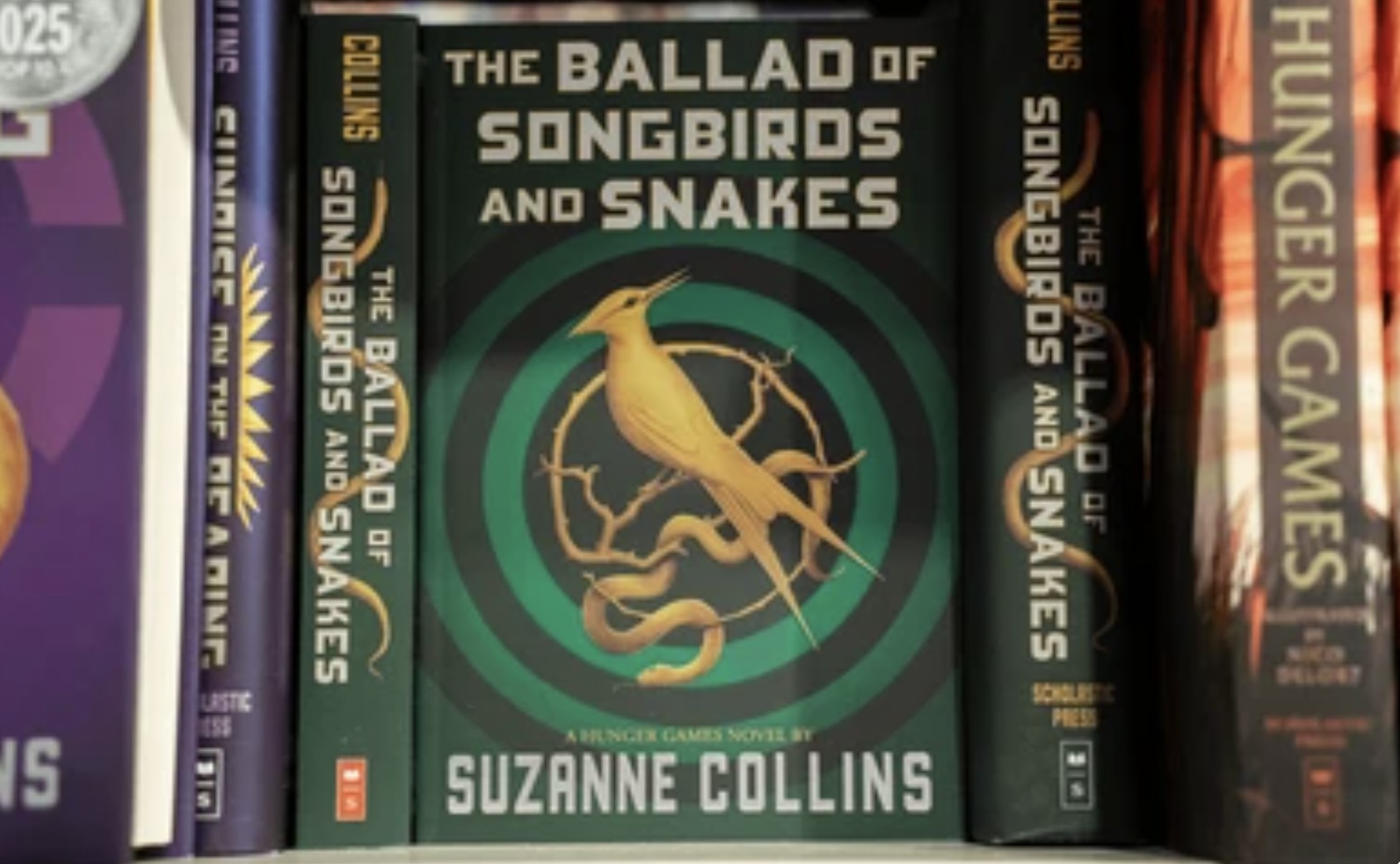
It is the morning of the reaping that will kick off the tenth annual Hunger Games. In the Capitol, eighteen-year-old Coriolanus Snow is preparing for his one shot at glory as a mentor in the Games. The once-mighty house of Snow has fallen on hard times, its fate hanging on the slender chance that Coriolanus will be able to outcharm, outwit, and outmaneuver his fellow students to mentor the winning tribute.
The odds are against him. He’s been given the humiliating assignment of mentoring the female tribute from District 12, the lowest of the low. Their fates are now completely intertwined — every choice Coriolanus makes could lead to favor or failure, triumph or ruin. Inside the arena, it will be a fight to the death. Outside the arena, Coriolanus starts to feel for his doomed tribute… and must weigh his need to follow the rules against his desire to survive no matter what it takes.[1]
I really liked this book; it’s really interesting to see the difference that 65 years can make for the Capitol. There aren’t any flashy costumes, surgical enhancements, dyed skin, or anything of that sort mentioned in The Ballad of Songbirds and Snakes. The whole Capitol is described as very modest and classy, mirroring President Snow’s demeanor in the main trilogy. The Hunger Games themselves are also very different from what they are by the time the 74th rolls around; instead of a high-speed train with decadent foods and luxurious living quarters, the tributes are shipped in livestock and cattle cars with no food. Instead of a 12-story tribute center with a penthouse, they are dumped in a monkey enclosure in the Capitol zoo. The difference in treatment between this book and the last 3 is drastic. We can somewhat see how the games turned into what it was in the 74th when the Academy is talking about ways to increase ratings in the games, and Coriolanus brings up betting, tribute interviews, and increasing brutality and drama for effect. This idea eventually turns the Hunger Games into the spectacle that it is in The Hunger Games and Catching Fire.
In The Ballad of Songbirds and Snakes novel, you are told the story through Coriolanus’s point of view, and his mindset and bias heavily impact the story being told. Snow is selfish and narrow-minded in the book; he can’t see how the people of the districts are anything but subhuman, and he only takes a liking to Lucy Gray because she says she’s not from 12, but Covey. Almost every decision Coriolanus makes in the books is based on financial and social-climbing moves. He is extremely manipulative of every situation he is in to favor himself, and his internal monologue really shows how vain and selfish he is. He often uses his friendships with people like Sejanus and Clemensia Dovecot to get what he needs by charming them, then turning his back on them when they can’t help him anymore. All of his most outstanding acts can be traced back to the influence of others around him. His only positive trait is how loyal he is to his family; everything he does is to preserve the fallen Snow name.
The Ballad of Songbirds and Snakes movie, however, lacks Snow’s internal monologue, and without it, you only see the persona he has around others. In the movie, Coriolanus Snow is shown as a likable protagonist; he’s depicted as humble, likeable, and selfless. He’s even an orphan who grew up in poverty: after District 13 was bombed, all of the Snow family’s munition bonds were gone, and they lost all their money. All of this gives the audience the impression that Snow was a good person before he “turned evil,” when that couldn’t be further from the truth. The movie also altered many of the events that occurred in the book, portraying Coriolanus as the innocent person being cheated by others, when that wasn’t the case. I don’t know why the director decided to depict Snow as the hero in this movie despite not being a good person in the book, but I guess that was just his interpretation.
Lucy Gray is a different character in the book than she is in the movie. In the movie, Lucy Gray is shown as this heavily rebellious character, singing to go against the Capitol and what they stand for. She’s a very selfless character, and only kills out of self-defense or by accident. In the books, however, Lucy Gray is a little more of a complex character than that. In the book, Lucy Gray is described to us through Snow’s bias’ and unreliable perception, which distorts her personality to fit within Snow’s mindset.
In the book, Lucy Gray is shown as less trustworthy than she is in the movies, and she is very cautious about whom she opens up to. She uses her singing and showy personality to charm others, similar to Coriolanus, and is what made them such a good pair. Multiple times throughout the novel, Snow thinks about how Lucy Gray would fit in with the people of the Capitol well, and even says he wants to hold her in his mansion forever at some point. Lucy Gray is also more cunning in the Games, not helpless like she is portrayed as in the movies. She knowingly uses rat poison against Reaper and Wovey in the novel, and sends a snake mutt to kill Treech in a hug. Her survival instincts are more deliberate in the novel, with her purposefully killing innocent tributes to save herself. The movie probably didn’t want people to see Lucy Gray as a bad person in the movie and side with Snow, so it makes sense why they changed Lucy Gray’s character.
In the movies, Clemensia’s character is very different. In the books, Clemensia is one of the top students in their grade, and is assigned an essay to work on with Coriolanus. After Arachne is killed, they both agree that they won’t be able to write the essay that night, but Coriolanus decides to write it anyway after he returns home, and they both agree to lie to Gaul and say they wrote it together. In the movies, however, Clemensia volunteers to help Coriolanus after Arachne is killed, and she claims to Gaul that she wrote it all herself. Gaul in the book also doesn’t tell Clemensia that the snakes will attack unfamiliar scents until after she puts her hand in the tank, which in the movie she tells her before, which makes Clemensia look desperate for praise, which just isn’t completely accurate.
Sejanus Plinth is one of my favorite characters in the book. Sejanus is originally from District 2, having moved to the Capitol with his family after the war ended 10 years prior. Despite living in the Capitol for 10 years, nobody sees him as a Capitol citizen, not even Sejanus himself. Nobody in the Capitol is phased by the horrific treatment of people in the Districts, it seems, except for Sejanus. He continuously has outbursts over the way the people of the districts are starved and killed, and nobody understands why. They all just think he’s crazy, including Coriolanus himself. Sejanus sees Snow as his best friend, as he is the only person who doesn’t ridicule him. In reality, however, Snow doesn’t respect Sejanus in the slightest; he sees him as a significantly lower class than him, and constantly judges his inherently “district” qualities like calling his mother “Ma”, speaking out of turn, and having basic empathy for others in general.
Overall, The Ballad of Songbirds and Snakes is a strong prequel that shows us the inner workings of the Capitol, and the mindset and motivations of the main antagonist of the original trilogy, President Snow. Although it was a little unsettling being in the mind of Snow, being able to understand his thought processes and how he justifies the treatment of the districts in his mind helps us to understand how so many people allowed the horror of the Hunger Games to be in place for more than 75 years. I highly recommend that you read this book along with the last 3 in the series, especially since another prequel novel was just released last March, and a new movie will be released in November of 2026.
- Collins, Suzanne. “The Ballad of Songbirds and Snakes.” Scholastic, Scholastic Inc., 2020, scholastic.com. Accessed 8 June 2026.
Leave a Reply