
I am Outcast.
The kids behind me laugh so loud I know they’re laughing about me. I can’t help myself. I turn around. It’s Rachel, surrounded by a bunch of kids wearing clothes that most definitely did not come from the East Side Mall. Rachel Bruin, my ex-best friend. She stares at something above my left ear. Words climb up my throat. This was the girl who suffered through Brownies with me, who taught me how to swim, who understood about my parents, who didn’t make fun of my bedroom. If there is anyone in the entire galaxy I am dying to tell what really happened, it’s Rachel. My throat burns.
Her eyes meet mine for a second. “I hate you,” she mouths silently.
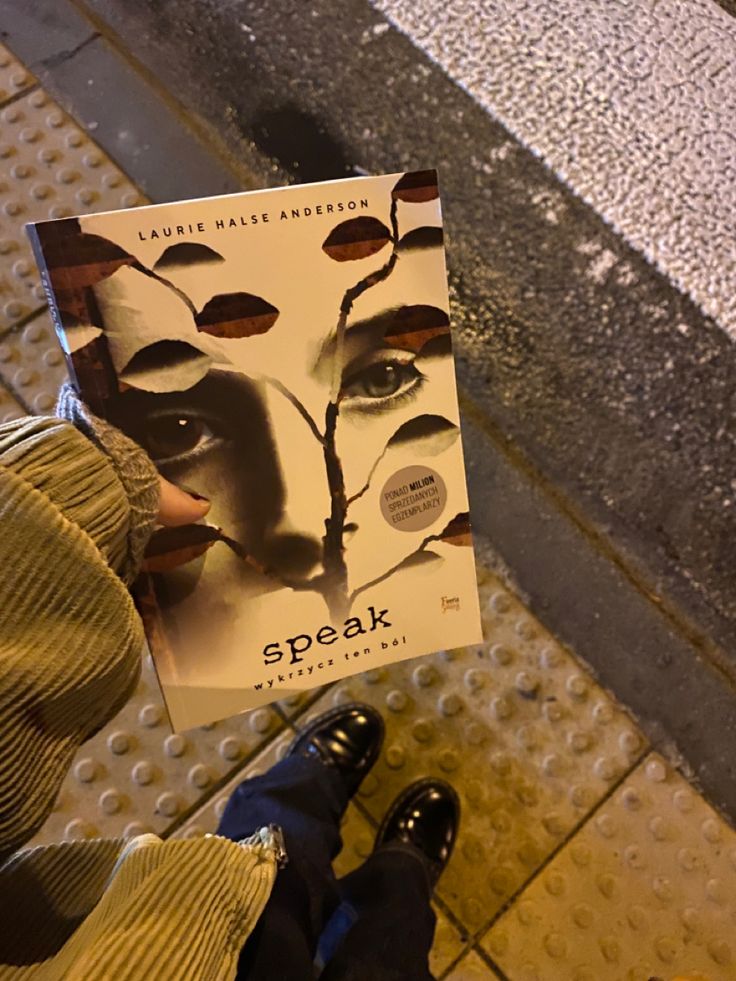
Melinda Sordino’s freshman year is off to a horrible start. She busted an end-of-summer party by calling the cops, and now her friends—and even strangers—all hate her. Months pass, and things aren’t getting better. She’s a pariah. The lowest of the low. Avoided by everyone. But eventually, she’ll reveal what happened at the party. And when she finally speaks the truth, everything will change.
Personally, I loved this book. Anderson goes out of her way to show Melinda’s perspective; we’re brought down to her level and see her high school experience through her eyes.
I loved Melinda’s voice and narration; it’s one of my favorite aspects of the whole book. The author does a great job at showing Melinda’s mental health issues while keeping her juvenile personality intact, despite the small amount of dialogue. It really feels like we’re hearing the story through the mind of a 14-year-old, with her depression adding a lot of weight to her words. She’s bitter, pessimistic, and surprisingly sharp, which leads to many witty remarks; I’ve even quoted a few on this page:
“There is a beast in my gut, I can hear it scraping away at my ribs. Even if I dump the memory, it will stay with me, staining me.”
“It is easier not to say anything. Shut your trap, button your lip, can it. All that crap you hear on TV about communication and expressing feelings is a lie. Nobody really wants to hear what you have to say.”
I also like how Anderson uses subtlety; she often alludes to what happened at the end-of-summer party through Melinda, but we never really know what happened that night until it is revealed to us more than halfway through the book. This helps build suspense around the incident, making the reader question what caused Melinda to dial 911 in the first place and what still bothers her today, adding more tension to the story. This also sets up the ending by highlighting the reactions of people around her after finding out, which makes it feel like a weight coming off Melinda’s and the readers’ shoulders
The irregular way this book is set up also adds to Melinda’s characterization: play-style dialogue, with the character’s name followed by a colon, helps show us how detached Melinda feels from everyone else and how she feels ostracized by her classmates. Throughout the book, Melinda consistently views herself as inferior to or different from everyone around her. She even admits it to herself: she’s a pariah. The lowest of the low. This dehumanization of herself is very apparent in the main story and is very common for survivors of sexual assault.
Melinda’s mental health issues are portrayed very well in Speak. From the beginning of the book, Melinda is describing the events of her freshman year in a very objective manner, with no sense of enthusiasm at all. This continues throughout the novel, with Melinda often uninterested in her studies, her classmates, and even her parents. She repeatedly skips her classes to read in an abandoned janitor’s closet, lies about taking tutoring lessons, and sneaks out at night, although she doesn’t do much more than bike around her town. This shows how much the rape Melinda experienced affected her, with her even reminiscing on how lively she used to be just a year prior.
Heather, Melinda’s new friend at the beginning of her 9th-grade year, is a good reminder of this; she is the example of how Melinda “should” be and highlights the contrast between them. Heather is new to their school, and very excited to finally be in high school. She is very optimistic about her freshman year and tries to join numerous different clubs and organizations, while Melinda couldn’t care less about participating in anything and is extremely pessimistic about high school.
This friendship, realistically, didn’t last the entire book, and we see Heather begin to distance herself from Melinda, eventually unfriending her after hearing about her reputation and how most people don’t like her. Heather has been striving for popularity, and it made sense story-wise that she would eventually drop Melinda as a friend. However, she eventually visits Melinda’s house and tries to ask her for help with a situation she is in with one of her cliques, and Melinda gets mad at her and yells about how she treated her. This scene really shows how Melinda has changed, if only slightly, from the beginning of the book to the end, and how she speaks out against Andy.
Something else I appreciated about this book is how the author uses other characters to drive the plot. Although Melinda rarely opens up to the people around her, she is still influenced by their actions and genuinely cares about how they perceive her. David Petrakis standing up to the teachers and Ivy speaking up against Andy Evans are two significant instances in which Melinda was encouraged, either directly or indirectly, to speak out about what she had experienced.
Leave a Reply