
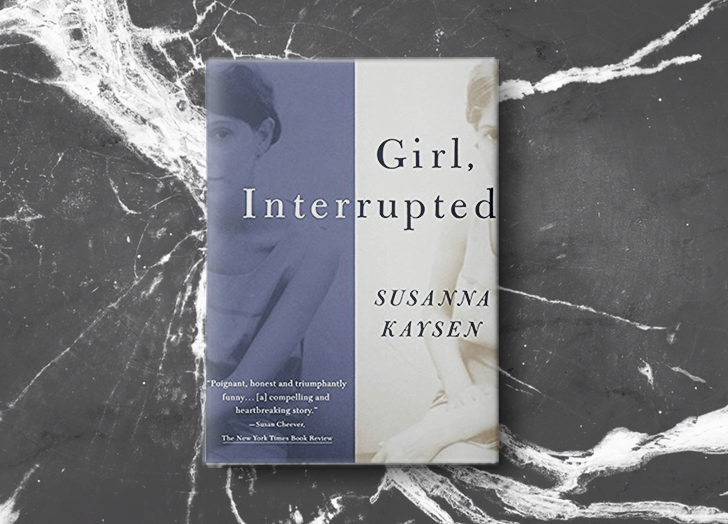
In 1967, after a session with a psychiatrist she’d never seen before, eighteen-year-old Susanna Kaysen was put in a taxi and sent to McLean Hospital. She spent most of the next two years on the ward for teenage girls in a psychiatric hospital as renowned for its famous clientele–Sylvia Plath, Robert Lowell, James Taylor, and Ray Charles–as for its progressive methods of treating those who could afford its sanctuary.
Kaysen’s memoir encompasses horror and razor-edged perception while providing vivid portraits of her fellow patients and their keepers. It is a brilliant evocation of a “parallel universe” set within the kaleidoscopically shifting landscape of the late sixties. “Girl, Interrupted” is a clear-sighted, unflinching document that gives lasting and specific dimension to our definitions of sane and insane, mental illness, and recovery.
Throughout this book, we follow Susanna as she adjusts to McLean, and we are introduced to many of the other patients at the facility; characters like: Lisa, a sociopath who often escapes the hospital and makes trouble for the staff; Polly, a schizophrenic girl who had set herself on fire; Georgina, who is also schizophrenic, is Susanna’s roomate, and one of the healthiest and most sane patients along with Susanna; Daisy, who stays from Thanksgiving through Christmas and has an unusual fascination for chicken; Torrey, a drug addict; Alice; and Cynthia. These characters help us understand what life was like in McLean, paint a picture of exactly what people there were going through, and show how the hospital dealt with those Issues.
I honestly really enjoyed this book. It’s a short novel, which makes it hard to include all the details and plot points you need to make a conventional book, but this isn’t a conventional book; it’s a memoir of Susanna and her real-life experiences that are written down so that we can see through her eyes and understand how she felt at that time in her life. It’s interesting how the book jumps back and forth in time, skipping over details only to describe them later. It threw me off a little at first, but I feel like it’s a really good way to show the cognitive dissonance someone would have in a place like that, and how Susanna valued the actions that happened rather than the timeline that they happened in.
I appreciate how Susanna depicts her mental state in this book; at the beginning, we’re a little confused about why she doesn’t strongly object to being sent to a mental hospital, and she seems relatively sane compared to other characters. She regularly questions her sanity, or rather insanity, and doesn’t really believe that she needs to be there, although she does appreciate the safety of the hospital. As the book progresses, however, we see Susanna’s mental state slowly deteriorate, although it’s probably more due to the conditions of the hospital than anything else; she’s constantly being exposed to people in a worse mental state than she is in, and she’s being treated like she is insane. She has little freedom to do anything and can only leave the wing of the hospital she is in, with people supervising her.
Despite this, almost all the patients in the hospital, including Susanna, are okay with being at McLean and actually prefer it to the outside world, as we see clearly in this book. Susanna talks about how the hospital is a “prison,” but it’s also a refuge from the overwhelming outside world. She constantly feels dehumanized, and like she doesn’t fit into the real world, and that the only people that will accept her are the patients and nurses at the hospital. She uses this to justify her stay countless times throughout the book, and by the end, we can still see Susanna struggling 30 years later.
Overall, I think Girl, Interrupted is an amazing memoir that digs through the traumatic mind of someone in a mental institution in the 60s, and shows how these people aren’t “broken” or incurable, but real people with real experiences who need to be treated that way. We see how dysfunctional McLean is, and how none of the things they try to do to “cure” the patients actually work.
“For many of us, the hospital was as much a refuge as it was a prison. Though we were cut off from the world and all the trouble we enjoyed stirring up out there, we were also cut off from the demands and expectations that had driven us crazy. What could be expected of us now that we were stowed away in a loony bin?”
“Boyfriends and literature: How can you make a life out of those two things? As it turns out, I did; more literature than boyfriends lately, but I guess you can’t have everything.”
Leave a Reply