

The young adolescent Melinda Sordino arrives at high school feeling confused, depressed, and alone. Her school peers call her “squealer” because she alerted the police during a summer party after she was sexually assaulted by Andy Evans. She refuses to tell anyone what happened. Her depression and distance from people are made worse by the increasingly large gap between her and her parents. She finds great support with her art teacher, Mr. Freeman, and her school friend, David Petrakis. Her feelings threaten to engulf her, but Melinda learns to grow from her experiences rather than repress the past emotions that have scarred her for the rest of her life.
I really liked this movie. I think it was a pretty accurate adaptation of the book, and the actors did a great job of depicting the different characters and their roles in the story. Kristen Stewart did an amazing job playing Melinda, especially with how complex Melinda is as a character.
I appreciate the flashback scenes to the night of the party that this movie includes. They reveal what happened that night scene by scene, only showing us certain events from that night after we’ve seen specific scenes from the main story to highlight the effects of Melinda being harassed. I also appreciate how they didn’t make the scene too graphic, mirroring the novel’s description of these events and their lack of detail. This is also realistic to how survivors of this kind of trauma react, blocking out specific details and trying to forget the experience entirely.
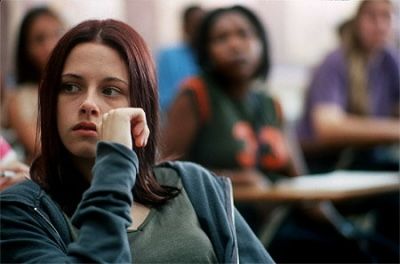
I liked how they included narration over the scenes to convey Melinda’s point of view. She hardly talks in the novel, and you can only understand how she feels in the situations she faces through her internal dialogue, which is hard to incorporate into a movie format without sounding repetitive or annoying. They get around this by adding narration only when necessary to convey Melinda’s thoughts, and by using her facial expressions or body language to communicate those feelings in other scenes. I think they did a good job of conveying Melinda’s feelings effectively while keeping the drama and life events center stage.
I also liked how they depicted Melinda’s old friends and acquaintances in the movie. In the book, we are only briefly introduced to these characters, and the information we get comes through Melinda’s internal monologue, which can be unreliable at times. In the book, Melinda often believes everyone around her hates her and holds an overall pessimistic view of people’s intentions, which, although realistic, especially given the trauma she endured at that party, definitely clouds her judgment of her peers. In the movie, however, we are directly shown Melinda’s classmates, and while the majority of them are rude and making fun of her, many people, some of her old friends specifically, look worried about Melinda, and are never shown to dislike her directly. This adds a more positive or hopeful aspect to the movie that isn’t present in the book, or at least not in a majority of its chapters.
Heather, Melinda’s new friend at the beginning of her 9th-grade year, is one of the more complex characters in this book; initially, she is the example of how Melinda “should” be and highlights the contrast between them. Heather is new to their school, and very excited to finally be in high school. She is very optimistic about her freshman year and tries to join numerous different clubs and organizations, while Melinda couldn’t care less about participating in anything and is extremely pessimistic about high school.
This friendship, realistically, didn’t last the full film, and we see Heather begin to distance herself from Melinda, eventually unfriending her after hearing about her reputation and that most people don’t like her. Heather has been striving for popularity, and it made sense story-wise that she would eventually unfriend Melinda. However, she eventually visits Melinda’s house and tries to ask her for help with a situation she is in with one of her cliques, and Melinda gets mad at her and yells about how she treated her. This scene really shows how Melinda has changed, if only slightly, from the beginning of the movie to the end, and how she speaks out against Andy.
Leave a Reply