

It’s now winter in District 12, and Katniss has settled down in her new home in the Victor’s Village with her family. She is about to embark on a ‘Victory Tour’ with her lover, Peeta, the problem being she hasn’t spoken more than a couple of sentences to him in months. After a particularly tense encounter with President Snow, where he demanded she convince the country of her love for Peeta, she is under even more pressure to perform her part.
They return from the Victory Tour in low spirits, seeing firsthand how riled up the districts are and how that may affect their livelihood and their families’. After Katniss, Peeta, and Haymitch push back against new security measures in 12, Snow announces the twist for the 75th Hunger Games, the 3rd “Quarter Quell”; 2 victors from each district are going to compete in the Hunger Games a second time, and Katniss, the only female victor from 12, will be among them.
In the summer, Katniss and Haymitch are reaped for the 75th Hunger Games, and Peeta volunteers to take Haymitch’s place, determined to save Katniss and have her crowned Victor. They travel to the Capitol once again and are treated like celebrities, and tensions between them and the other skilled victors from the other districts rise. They realize that it’s not going to be like it was the year prior; before, they were going against 22 other teenagers, this year they’re going against 22 skilled killers.
Catching Fire is probably my all-time favorite movie of the Hunger Games franchise; there is so much political tension in the districts and the progression of the rebellion is pretty realistic. Francis Lawrence’s direction really brought a lot to the production; the movie as a whole looks very polished, with the high-quality camera work highlighting the luxury and prestige of the Capitol, although the shaky camera that Gary Ross favored in the first movie brought out the poverty of the districts nicely.
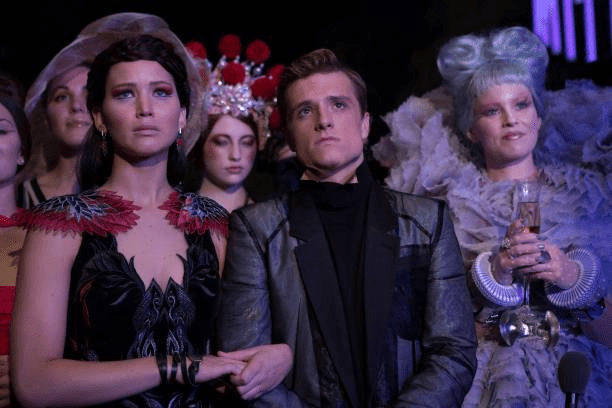
I appreciate how the progression of the rebellion in the districts was handled in the movie. Without Katniss’ narration, it’s hard to fully show the extent of the Capitol and the harm that they cause their people, but this movie does a good enough job at showing the distrust the people have in the Capitol. Throughout the Victory Tour, we see many districts’ population, filled with malnourished and angry people. Katniss and Peeta try to say what they need to say to diminish the anger of the districts, but it only makes it worse.
I also liked Catching Fire‘s depiction of the militarization of the peacekeepers in District 12. Beforehand, the peacekeepers in 12 were described as lenient and laid back, with Katniss even mentioning selling illegally-hunted deer to them in the first movie. This changes in Catching Fire, when Snow brings in an army of peacekeepers to control the district, harming civilians and burning down shops along the way. This helps to show the power of the Capitol in times like these, with them effectively diminishing the ‘fire’ of the rebellion, in District 12 at least.
This movie, although leaving out details from the novel, still effectively shows the frustration that the Capitol citizens have with their government. We see multiple instances of Capitol citizens working alongside the rebellion, with characters like Cinna and Plutarch being especially involved. The interviews with Caesar Flickerman also heavily showcased this, with many of the tributes making sob stories about themselves or discussing how unfair it is that they have to go back into the area, and how the Capitol should cancel the games. Cinna altering Katniss’ wedding dress to burn into a mockingjay, although mainly directed to the people of the districts who know it as a symbol of rebellion, also resonates with the people of the Capitol when they witness the ‘burning’ of her wedding dress. The tension boils over when Peeta drops the bomb of Katniss’ (fake) pregnancy, which causes citizens of the Capitol to cry out to stop the games, which is particularly ironic when you consider the fact that people had no problem with the slaughter of 12-18 year old children in the years prior, only when a fetus is involved it is deemed inhumane.
One thing that I didn’t appreciate about this movie is the amount of plot that was cut out in the book-to-screen adaptation. The Catching Fire novel had so many underlying details about the rebellion and District 13, with Katniss even encountering a few rebels from District 8 who escaped after a violent riot on their way to District 13. This, along with more small details about the rebellion, added a level of depth to the novel that was lost in the movies. I understand the reasoning behind cutting out these scenes; they couldn’t release a 4+ hour movie, but I feel like the plot twist of the rebellion and District 13 at the end of this movie was very sudden and came out of nowhere, especially for people who have never read the book before.
Along with cutting out scenes that were important for the plot, the Catching Fire movie also cut out many scenes that furthered character development. In the novel, there were many scenes of Katniss and Peeta comforting each other over PTSD and other issues, which furthered their relationship and helped them feel comfortable around each other. Small cuts like these, while seeming minor at first, take away a lot from the movie’s plot and diminish the story’s depth. I know most people probably wouldn’t appreciate a movie with all of the scenes from the book included, but I would 100% sit down to watch that.
Leave a Reply